The AI reckoning
AI agents will transform business in 2027, bringing new cyber, infrastructure, regulatory and social risks. Explore how organisations can build resilience.

The no rules/new rules world that we elaborated last year will continue to play out in 2027; risk will be unavoidable. Increased geopolitical volatility is confronting organisations with a wider range of potential threats, impacts, and scenarios than before. Despite a clear trend towards fragmentation, the world remains – for now – highly integrated and interdependent. What happens over there affects us over here, transmitted through supply chains, energy markets, financial systems, computer networks, climate patterns, and global travel. In many cases, AI will accelerate how quickly this happens.
Risk has a negative connotation. Organisations manage risks by trying to reduce the likelihood or impact of bad things happening. Any discussion of risk invariably turns towards potential crises and worst-case scenarios as organisations look to avoid strategic surprise.
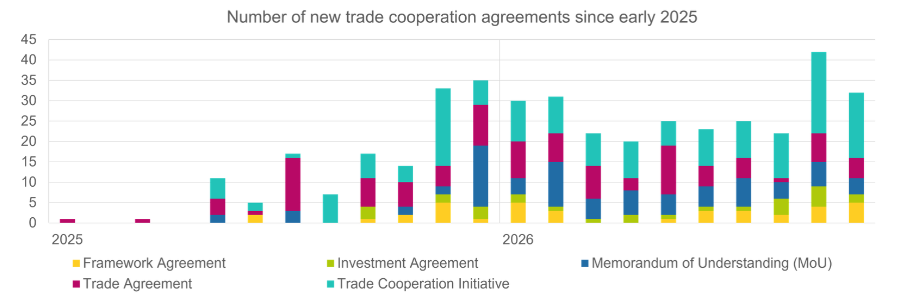
Source: Control Risks Global Trade War Tracker
Diversification is the core of geopolitical resilience. Organisations – and countries – are moving to reduce dependence on unreliable suppliers and exposure to single points of failure. It shows up in the number of trade deals, infrastructure projects, and defence arrangements launched over the last two years. It is a bet that volatility is the new normal and that diversification will pay off over the long term.
In the short term, however, resilience can be costly. Public budgets are straining to finance infrastructure investments and subsidise domestic manufacturing. Stockpiling and redundancy require substantial up-front investment. Diversifying suppliers reduces economies of scale and leverage in contract negotiations. Operating in a new country, domain or sphere brings new security, integrity, and political challenges.
Polarised politics and unsustainable deficits are weighing on advanced economies in Europe, North America, and Asia. Geopolitical rivalries are powering industrial policy and protectionism, threatening long-standing trade and security alliances. Economic inequality is rising in many countries and growth is increasingly concentrated – precariously – in a handful of sectors.
Frontier markets are traditionally a byword for risk, but many are increasingly sophisticated economies with significant investment and growth potential – especially in sectors like critical minerals. Lower barriers to foreign investment coupled with improving security and political stability make them more attractive despite their relatively small size. Several economies in Africa and Latin America have recently regained access to international capital markets.
Strategic calculations are also driving increased interest in frontier markets. Energy security considerations and structurally higher prices following disruptions at Middle East chokepoints enhance the strategic value and commercial potential of alternative oil and gas suppliers.
Western efforts to diversify critical mineral supply chains away from China are driving investment into new locations in Africa and Latin America. The democratisation of technology – from vibe coding to fintech – is converting young, tech-savvy populations in frontier markets into new markets and attractive talent pools.
It’s not just different countries: investment is also flowing into frontier domains, including space, the Arctic, quantum computing, and the deep sea. These areas are opening up due to technological innovation and environmental change, and they will further develop in 2027 into arenas of geopolitical rivalry and commercial competition.
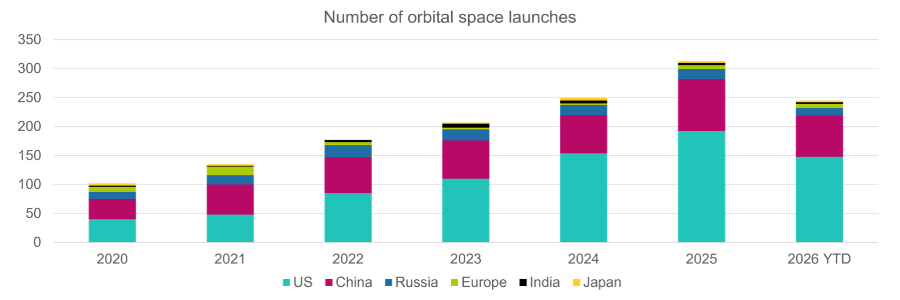
The space economy is growing rapidly and more countries are developing orbital launch capability to ensure their access to low-earth orbit. Much of this activity supports terrestrial sectors such as transportation, energy, agriculture, communication and finance that are increasingly reliant on satellite communications, imaging, and positioning. Where countries go, however, geopolitics follows: the US and China are engaged in a new space race for a manned moon landing, while the US and Russia are overtly and covertly deploying space-based weapons.
The Arctic economy, meanwhile, is heating up, as climate change gradually unlocks new shipping routes and the hunt for critical minerals and other resources expands north. The Middle East conflict is a fillip for the Northern Sea Route, which shaves Asia-to-Europe shipping times by 10 days, cuts fuel costs by up to 25%, and avoids increasingly threatened chokepoints. The US play for Greenland, meanwhile, raised the strategic stakes for the region and its abundant mineral, energy, and fishing resources.
Further quantum computing breakthroughs will occur in 2027, although practical quantum computing is likely still years away. Still, organisations should plan and take action now to build resilience against quantum decryption (for example, by adopting quantum-resistant algorithms), and consider how quantum computing could impact research and development, financial stability, and supply chain integrity.
International negotiations to regulate deep sea mining are proceeding slowly, and some countries are not waiting for consensus. 2027 could see commercial-scale mining operations begin in the Pacific Ocean as efforts to build secure and resilient critical mineral supply chains intensify.
Frontier markets and domains are the axis of opportunity in 2027. Operating at the frontier, however, requires diligent risk management to understand new geographies and fast-moving regulatory regimes. Expert local knowledge will be critical to assessing opportunities in frontier markets and emerging sectors. Organisations need to:
AI agents will transform business in 2027, bringing new cyber, infrastructure, regulatory and social risks. Explore how organisations can build resilience.
Extreme heat will intensify pressure on infrastructure, supply chains and food security. Explore how organisations can adapt and build resilience.
Critical infrastructure is becoming a frontline of geopolitical competition. Explore the threats to strategic assets and how organisations can respond.

As AI moves from advice to decisions, human oversight matters more than ever. Explore how organisations can balance automation with judgement and accountability.
Where is risk rising, falling or changing? Explore our global and regional RiskMap 2027 maps and country risk ratings to see how the operating environment is evolving across the markets that matter to you.

Control Risks CEO Bill Udell looks beyond the individual risks to consider what they mean collectively for leaders making decisions in an increasingly complex global environment, and how businesses can prepare for what comes next.
Explore what the RiskMap outlook means for your markets, investments, operations, people and strategic priorities with our experts. From a bespoke briefing to specialist advice, our strategic intelligence and security teams can help you understand your exposure, and make confident business decisions.