
For high-net-worth individuals and their loved ones, the greatest driver of risk is not wealth, but visibility. Understanding where that visibility creates exposure is the first step toward protecting your lifestyle, without restricting it.
Older security models zoned in on defending against violent crime, kidnap and physical attacks. But there has been a meaningful shift in how affluent families think about their protection, as physical, digital and reputational risks have converged. The better question now is, "What about us is visible, to whom, and why does it matter?" Answer that, and protection becomes precise, proportionate and, crucially, invisible in daily life.
The risk in being seen
Wealth has always attracted attention. What has changed is how easily attention converts into exposure.
Living life and doing business inevitably creates a trail of information. Much of it is already publicly available, scattered across property records, corporate filings, social media and the everyday digital footprints of family life. Examples include a planning application with the layout of a home, a school prize-giving photograph, a teenager's geotagged post from a ski chalet or a business filing naming a beneficial owner.
This is often magnified for families who live across borders. Moving between Asia, the Gulf and Australia multiply the property records, corporate structures and school and social footprints attached to a single family, and each jurisdiction adds its own layer of public information. The result is a wider, more scattered trail than most families realise.
This information may seem innocuous in isolation, but when these fragments are pieced together, they can reveal where a family lives, how it moves, who it trusts and when it is most predictable. For a threat actor, assembling that picture requires little effort. As the information already exists, the challenge is simply connecting the dots.
The uncomfortable truth is that this exposure is rarely the result of a sophisticated intrusion. It is largely self-generated and avoidable. Families have every right to live an open, public-facing life, provided they understand how this information accumulates and the footprint it creates.
From screen to street
Digital, physical and reputational risks were once managed separately, by different advisers, on different timelines. That separation no longer reflects how threats actually develop.
Today, a single grievance moves seamlessly between these worlds. Hostile sentiment often surfaces online first, before becoming attached to a person, family or business. From there, a threat actor can use publicly available information to build a detailed picture of locations, relationships and vulnerabilities. What begins as a reputational issue or activist campaign becomes a physical threat the moment someone decides to act on it. In many cases, digital signals precede a real-world incident, often well in advance.
Reputation deserves particular attention here, because it is rarely just a matter of image. Hostile narratives, leaks and misinformation can move markets, sour negotiations and, left unchecked, harden into the grievance that motivates someone to act. Managing what is said about a family is therefore part of managing their physical safety, not a separate exercise.
When a determined threat actor decides to target a high-net-worth individual, they turn to mapping addresses, routines and moments of predictability that can be exploited. With the earliest and most reliable indicators of physical threat now often surfacing online, security strategies centred solely on fences and fortresses risk watching for the wrong thing too late. The perimeter of a modern family is informational before it is ever physical.
Seeing what they see
Before considering equipment or security guards, families should undergo an honest assessment of this informational perimeter or what a motivated outsider can discover about them.
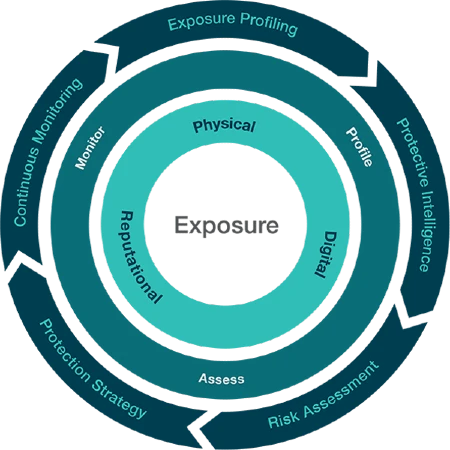
A digital risk profile maps what is genuinely visible about a principal and their family, drawing on open sources, public records, data-broker listings, breached credentials and social media. This work relies only on information that is legally and ethically accessible, approached from the perspective of someone who might wish the family harm, but without any form of hacking or intrusion. The findings are prioritised by real-world relevance. The purpose is not to alarm, but to replace assumption with fact, so that decisions rest on evidence rather than instinct.
Protective intelligence keeps the picture current. Ongoing monitoring runs across open sources, social media, data-broker listings, deep and dark web venues and fringe networks, tracking emerging concerns, hostile narratives and targeting behaviour. Serious threats are separated from the noise, with intent, capability and proximity assessed using human judgement, inside clear legal and privacy safeguards.
Credible threats are investigated before families either over-react or, more dangerously, do nothing at all. Continuous monitoring sits alongside our 24/7 Global Risk and Operations Centre (G-ROC), which reviews and prioritises alerts, notifies the right people, coordinates response across teams and locations and stays across an incident through to resolution
Control Risks One Elite is a dedicated G-ROC hotline for high-net worth families or individuals, answered at any hour by people who already hold their risk picture, instead of a general switchboard. This gives the whole household - from principaland spouse to family and staff members - access to an analyst when they need it, so no-one is left alone and no incident escalation missed.
The weakest link is rarely the principal
A target often becomes exposed by the people around them.
- Children and younger family members share locations, school lives and routines. This openness is natural to them and revealing to an observer.
- Household staff can discuss employers, schedules and travel revealing a family's rhythm in detail.
- Travel patterns repeated over time turn privacy into predictability.
- Publicly available information can connect carefully structured ownership to the front door of a home or office.
None of this is necessarily unusual or careless behaviour. But it means any credible assessment must extend to spouses, children, assistants and staff — and that short, practical awareness sessions for family members and household employees often remove more risk than any additional hardware. Knowing what not to post, and knowing that One Elite is the number to call when something feels wrong, is a meaningful control in its own right.
Proportion is the point
Once exposure is understood, a security plan can be matched precisely to it. The result is protection with minimal impact on the lives it is designed to protect.
Deploying guards at every point or implementing restrictive checks and systems is both unnecessarily expensive and counterproductive. Intelligence-led protection concentrates efforts where evidence shows it is warranted, with the added benefit of enabling discretion over disruption.
In practice, the most useful output is often the simplest: a short, prioritised list of practical steps, ranked by the risk they remove and how easily they can be put in place. That lets a family see immediately which actions deliver the greatest protection for the least friction, and act on them without disrupting daily life.
Proportion applies to escalation as much as to guards and gates. Agreeing in advance what warrants a call, who makes which decision and how far it travels means that when something does happen, no one is improvising. Thresholds are set once, applied consistently by the G-ROC around the clock, and reviewed as circumstances change, so only the situations that genuinely need a response generate one.
This is what separates protection based on status from an intelligence-led plan focusing on risk. A family's profile, prominence or wealth may suggest a level of risk, but only a complete, accurate assessment and continuous monitoring can determine where threats are real, emerging or evolving.
Handled well, this approach does not shrink a family's world. It protects the lifestyle, mobility and public engagement that matter to them, quietly reducing unnecessary exposure while leaving daily life intact. A prominent person can still speak at a conference, support a cause and travel freely, knowing that the risks around those choices are understood and managed.
From fear to confidence
Intelligence-led protection can change the way a family thinks about security. Rather than an unwelcome restraint imposed in response to fear, it becomes a source of confidence. A clear picture of exposure can help make critical life decisions easier, like where to live, how to travel and what to share.
The reality is that visibility is part of modern life. The answer is not to withdraw from it, but to understand it. By taking this approach, families can move through their cities, careers and relationships on their own terms, protecting their lifestyle instead of limiting it.