
Worsening socioeconomic disparities, a fractious geopolitical landscape and the proliferation of transnational organised crime will continue to drive increases in kidnaps-for-ransom, extortion and behavioural threat incidents globally in 2026.
While much of the world’s attention remains focused on major geopolitical developments, businesses continue to face a broadening and increasingly complex range of extortive and behavioural threats at an operational level. These trends are not confined to traditionally high-risk environments, and in many cases are evolving in parallel with wider political, economic and technological shifts.
Geopolitical shifts and criminal adaptability
Kidnap and extortion groups will maintain the ability to exploit, react to and adapt to shifts in the geopolitical and security environment globally. As the attention of governments and regional powers diverts away from day-to-day security and towards more wide-ranging concerns, kidnappers will exploit the vacuum to escalate their existing activities and explore others.
Recent events illustrate this dynamic. The re-emergence of Somali piracy during the Iran-Israel conflict, for example, reflects how criminal gangs are able to capitalise on shifting maritime patterns and reduced oversight. The diversion of shipping away from the Red Sea creates conditions in which more vulnerable vessels could be targeted.
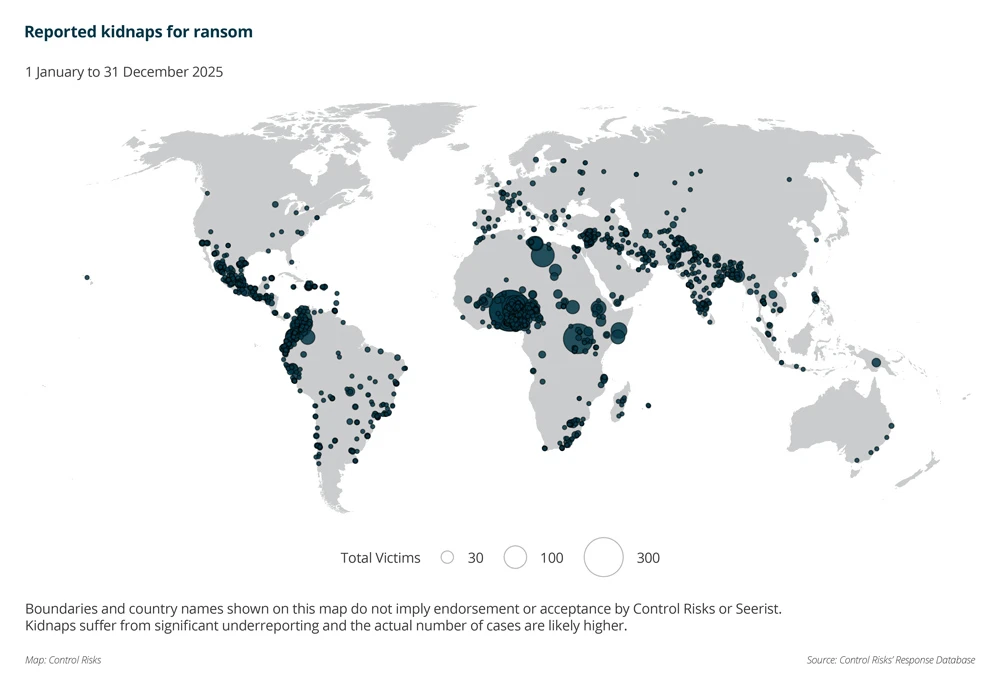
While the effects of geopolitical shifts will be most pronounced in their long-term economic and regulatory impacts, businesses will have to remain vigilant for the evolution of extortive crime. Control Risks’ data over the past five years indicates the number of kidnaps steadily increasing as the geopolitical picture becomes more opaque. Recorded kidnaps in 2025 were 60% higher than in 2020, with increases occurring across every region of the world except the Asia Pacific.
Diversifying tactics to meet different environments
Between 2020 and 2025, Control Risks has seen a marked diversification in the tactics adopted by kidnappers, as they adapt to the economic and security conditions where they operate. This includes countries with historically benign security environments, where gangs typically uninvolved in kidnapping alter their tactics to pursue new victim demographics.
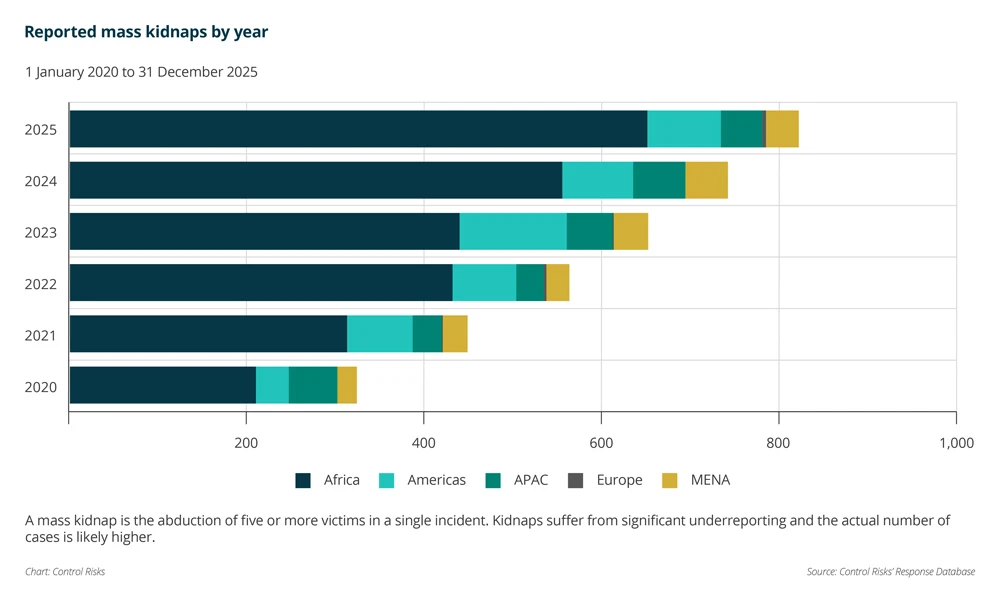
Countries and regions with lower per-capita wealth, particularly those facing localised civil conflicts, have seen a substantial escalation in mass kidnaps, where five or more victims are taken in one incident and commonly held for a collective ransom. According to Control Risks’ data, the recorded number of mass kidnaps globally increased by 154% in 2025 compared to 2020, with Nigeria representing a notable hotspot.
Kidnap gangs have also become increasingly bold in their approach, emptying victims’ bank accounts through their mobile banking apps even before demanding a ransom from an outside party. Across publicly reported incidents in more permissive countries such as Haiti, Mexico and Nigeria, highly capable groups have become increasingly willing to renege on agreed ransom settlements, taking the first payment and then issuing a second demand while still holding the victim.
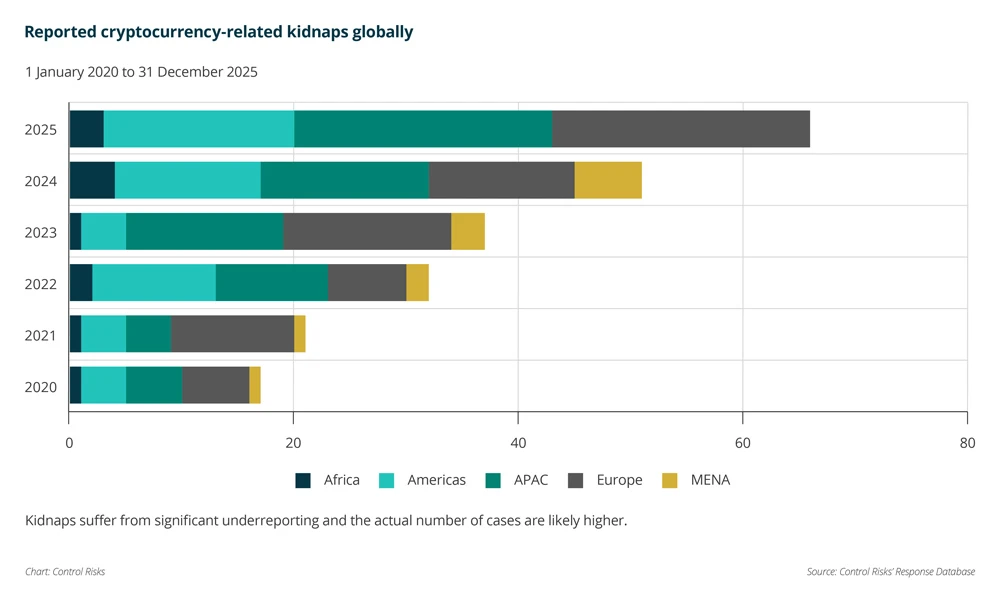
Meanwhile in perceivably lower-risk countries, the proliferation of the crypto-currency sector and the significant sums available in individual crypto wallets has prompted criminals to adopt kidnapping in the hope of extorting substantial payments. This phenomenon saw a notable increase in Europe, with France in particular seeing a spate of incidents over the past two years.
Expanding extortion threat landscape
Beyond kidnapping, businesses will face a continually escalating threat from extortionists, ranging from transnational organised crime groups to lower-level opportunists.
The proliferation of transnational gangs across international borders has both increased the capability of, and emboldened, local gangs in a range of countries. This was most notable in Latin America, where the Tren de Aragua group has consolidated ties with local groups in Ecuador, Colombia and Brazil in particular. These groups have widely used their newfound connections and experience to bolster extortion efforts, in some cases resorting to kidnapping to enforce demands when companies resist.
In lower-risk environments, businesses continue to face threat extortions from opportunistic criminals. These perpetrators will continue to leverage the anonymity provided by remote communication and rely on (often falsified) threats of holding compromising information on organisations or senior leadership to extort a payment. The advent of generative AI will increasingly bolster these threat actors by allowing them to tailor messaging and generate “proof” of their extortion claims to increase the credibility of their threats.
Rising behavioural and grievance-driven threat
Unlike threat extortion, threats of violence are typically associated with personal or collective grievances. Organisations today are operating in an unrelenting climate of political polarization, social unrest and online incivility. Control Risks’ own caseload has been a reflection of this: the numbers of behavioural threat cases Control Risks responded to globally in 2025 exceeded the total in 2020 by 566%.

Our multidisciplinary expertise includes eight former FBI Behavioral Analysis Unit certified profilers in addition to a Forensic Psychiatrist and Forensic Psychologist, supporting our clients in preventing, identifying, assessing and managing these threats.
Perceived anonymity and ease of online access have lowered barriers for conveying threats. Problematic behaviour and concerning communications could emanate from both internal and external threat actors. The risks may multiply when a company becomes associated with a controversial sociopolitical issue.
While the foremost concern remains violence against people or property, potential liability exposures include, but are not limited to, allegations of insufficient duty of care, reputational harm, resource strain, lack of board level oversight and financial risk.
Outlook
The trends shaping kidnap, extortion and threat tactics between 2020 and 2025 will continue through 2026 and beyond, withbusinesses facing an increasingly complex environment in which to protect their people and operations.
- Sectors that historically had limited exposure to extortive crime will need to consider the risk to their personnel, as groups diversify their pool of potential victims.
- Threat actors are increasingly targeting organisations in lower-risk markets, signalling a broadening of kidnapping and extortion risk beyond traditional high-risk regions.
- AI and digital platforms are reshaping extortion tactics, enabling more scalable, anonymous and credible threat campaigns.
Taken together, these developments reinforce the need for organisations to adopt an integrated approach that combines intelligence, behavioural insight and crisis management capabilities.
For more information, listen to our Ground Truth episode on kidnap and extortion.