
This article is based on content originally published on our partner platform Seerist, the augmented analytics solution for threat and risk intelligence professionals.
The Canadian federal government hosted the inaugural Canada Investment Summit on 14-15 September 2026. Here, we assess the outlook for the government’s efforts to attract foreign investment and strengthen domestic economic resilience.
A first for Canada
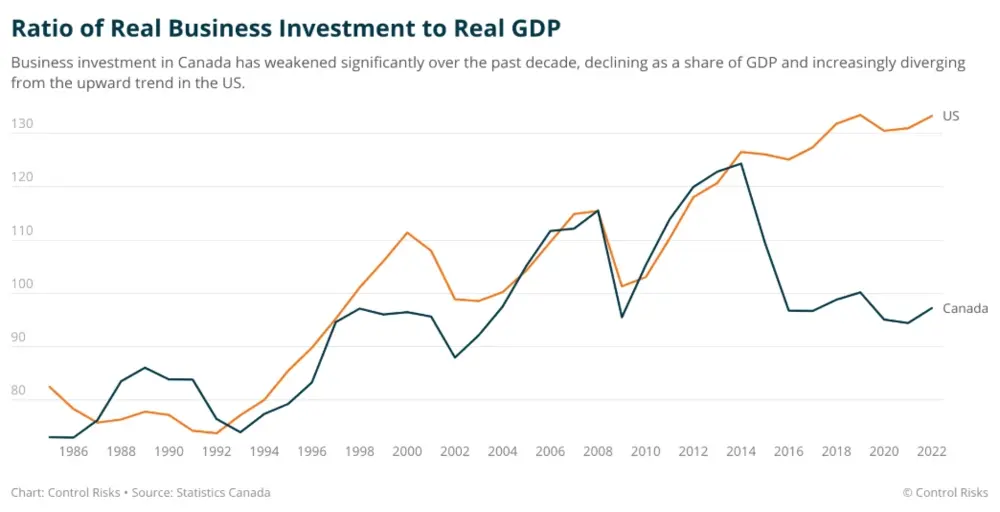
The Canada Investment Summit brought together investors from nearly 30 countries managing more than CAD 100 trn (USD 71.4 trn) in assets, in efforts to catalyze investment in Canadian infrastructure and strategic sectors. The gathering forms part of Prime Minister Mark Carney’s economic initiative to mobilize CAD 1 trn (USD 717bn) in investment over five years. The aim is to reverse a decline in business investment as a share of GDP over the past decade. This decline was in part due to Canada’s relatively low labour productivity compared with the US and other G7 countries, as well as perceived environmental and permitting obstacles to investment.
- Ottawa will accelerate pro-investment regulatory reforms in the coming months, leveraging the governing Liberals’ strong polling position to reduce tax burdens and fast-track major infrastructure projects.
- Geopolitical volatility will continue to raise Canada’s strategic value as a stable supplier of crude oil, natural gas and critical minerals globally.
- Businesses in energy, mining, defence, transportation and technology are likely to see the strongest growth opportunities as domestic and geopolitical drivers channel capital toward projects strengthening resilience.
- Nevertheless, stronger government support for AI, defence and fossil fuel projects will fuel legislative and activist opposition over climate impacts and social spending, increasing unrest and integrity risks.
Carney has increasingly sought to supplement Canada’s traditional advantages – rule of law, a natural resource base and access to free trade agreements – with industrial policy, tax reform and deregulatory measures to improve Canada’s attractiveness to investors. Key measures include the June 2025 Building Canada Act to fast-track projects deemed in the national interest, and the February CAD 6.6bn (USD 4.7bn) Defence Industrial Strategy to bolster Canada’s industrial base. The summit likely served both to build public support for measures aimed at strengthening economic resilience, and to broaden Canada’s appeal to international investors.
These objectives were reflected in Carney’s 17 September address to the European Parliament, where he called for “a deeper partnership between Canada and Europe”, a day after European Commission President Ursula von der Leyen proposed that Canada become an “associate member” of the EU. While the proposal reflects growing interest in close Canada-EU co-operation, a formal change in the relationship is unlikely in the coming year. This is due to the absence of an established framework for “associate membership” and opposition among several EU member states, partly driven by resistance from domestic agricultural groups.
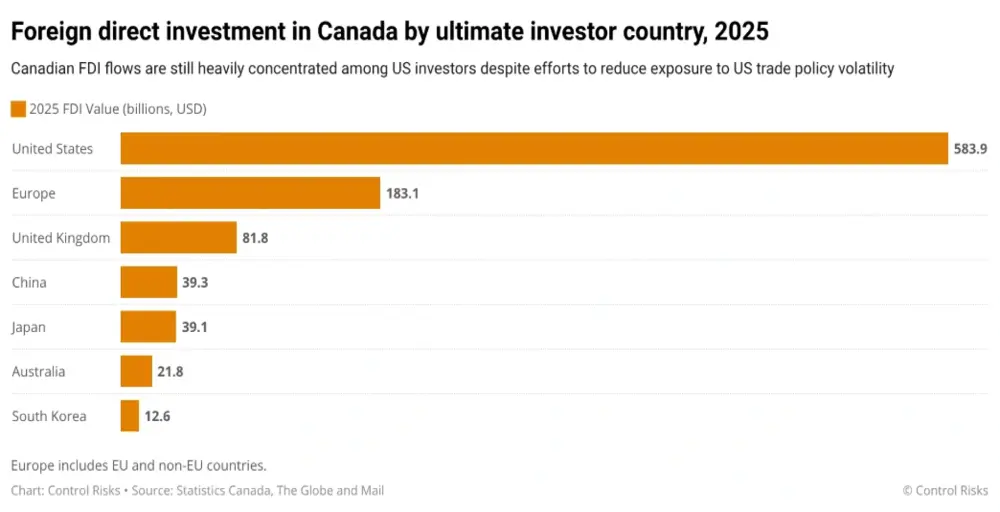
The move nonetheless reflects Ottawa’s push to encourage investment that reduces dependence on the US or China, echoing Carney’s call for middle powers to strengthen trade and security co-operation as leading economies increasingly weaponize tariffs and supply chains as tools of leverage. Although the US remained Canada’s largest trading partner in 2025, with USD 872bn in goods and services trade, higher US tariffs contributed to a 5.3% decline in Canadian merchandise exports. By contrast, exports to the EU, Canada’s second-largest trading partner, rose 23.4%, with bilateral goods and services trade reaching USD 127bn. Deeper engagement with Europe will likely be critical to Ottawa’s investment-attraction objectives: the EU was Canada’s largest source of FDI after the US in 2025.
Pro-business reforms
Regulatory reforms, including taxation changes, will be central to the federal government’s efforts to improve Canada’s investment climate. A May survey from the Global Infrastructure Investor Association showed that project pipeline visibility – uncertainty over which projects will be approved, when they will reach the market and under what conditions – is perceived by investors to be the biggest barrier to investment in Canada, scoring higher in investor sentiment data than any barrier recorded for the UK or EU. On 9 September, Ottawa announced regulatory changes removing certain interprovincial infrastructure projects, including pipelines and power lines, from the Impact Assessment Act and shifting their assessment to the Canada Energy Regulator (CER) under a single-regulator process. On 14 September, the federal government also introduced “advanced tax rulings” for investments exceeding CAD 1bn (USD 717m) and expanded the Productivity-Super Deduction, cutting Canada’s marginal effective tax rate on new investment from roughly 13% to 6.4%, the lowest in the G7.
Ottawa is likely to capitalize on rising support for the Liberal government to facilitate the advance of reforms that could otherwise face greater opposition. A September Abacus Data poll showing the Liberals 14 points ahead of the Conservatives – their largest lead since May 2017 – indicates that Carney’s strategy of framing resistance to US pressure and the defence of Canadian sovereignty as a core political platform is strengthening Liberal support. To maintain support for its pro-business reforms, the government will need to demonstrate that it is increasing inbound FDI and reversing weak business investment, while using the goal of reduced reliance on the US to build support for greater investment.
However, 2026 inflows suggest that recent FDI growth has largely reflected transfers of Canadian asset ownership to US investors, without necessarily generating new productive capacity. Mergers and acquisitions accounted for nearly half of 2025 FDI, with reinvested earnings and new capital expenditure lagging. According to a C.D. Howe Institute Report published in March, the historical average is one third. Inbound investment in Canada is also unusually concentrated among US investors, who accounted for over two thirds of inflows, compared with an annual average of 26%. Tax reform and deregulatory measures could therefore face popular resistance that translates into political pressure if rising investment fails to lift productivity or is perceived to primarily benefit large corporations. Persistent cost-of-living pressures heighten this risk: a 13 September Abacus Data poll found that 65% of Canadians ranked the cost of living among the country’s three most important issues, up three percentage points in a two-week period.
Selling certainty
Ottawa will use rising geopolitical volatility to elevate Canada’s appeal as a stable partner. The use of strategic chokepoints and supply chains as tools of geopolitical leverage has increased the premium that investors place on secure and diversified supply, particularly of natural resources. Disruptions to commercial shipping through the Strait of Hormuz amid the Middle East conflict, and China’s expanded rare-earth export restrictions, have brought into stark focus the vulnerabilities of global energy and critical-mineral supply chains.
In June, G7 leaders committed to diversifying energy supplies and increasing stockpiles to reduce vulnerability to Strait of Hormuz disruptions, highlighting Canada’s potential to expand global oil supplies. Canada’s growing strategic importance was reflected on 12 August, when Japanese Prime Minister Takaichi Sanae announced the arrival of the first Canadian crude oil tanker in Japan since the start of the Middle East conflict, calling Canada an “important partner” for economic security. Ottawa’s 21 August decision to suspend trade negotiations with the US likely reflects the strategic value of this narrative. By framing Canada’s response to US trade volatility around greater economic resilience and diversification, Carney can advance priorities to diversify trade and accelerate nationally significant projects, while attracting the economic and political capital needed to do so.
Reinforcing this message, Carney stated on 15 September that Canada intends to emerge from the trade dispute “stronger, more resilient, more independent”, signaling a willingness to withstand higher US tariffs to obtain a more favourable deal later. The sovereignty narrative is also encouraging greater domestic investment: during the summit, leading Canadian pension funds and banks committed nearly CAD 425bn (USD 303bn) in capital and financing for Canadian infrastructure.
Outlook
Businesses in sectors critical to Canada’s economic resilience, including technology, mining, transportation and energy, are likely to benefit from Ottawa’s efforts to attract foreign investment. Data centres and digital infrastructure are particularly well positioned due to Canada’s proximity to US markets, reliable power supply and cooler climate, while clean energy and battery-material projects will gain from strong demand for Canada’s resources.
Bell Canada’s 14 September announcement of a CAD 52bn (USD 35.8bn) AI data-centre expansion in Saskatchewan reflects the scale of emerging opportunities. Nevertheless, foreign investment in critical minerals, defence, AI, advanced manufacturing and infrastructure will continue to face heightened scrutiny on national security grounds under the Investment Canada Act. Businesses should account for potential reviews early in transaction planning, as these can apply regardless of deal size or control.
Integrity and unrest risks are likely to increase as Ottawa expands support for resource and infrastructure projects. Environmental activism remains a key challenge to resource development, while stronger government backing for AI, defence and fossil fuel projects will likely draw opposition from groups prioritizing climate action and social spending. More than 1,000 environmental, labour and Indigenous activists protested against the summit in downtown Toronto on 15 September, with police reporting two arrests after attempts to block a road. Plans to expand private investment in Canada’s four largest airports are likely to attract similar heightened protest activity and reputational scrutiny.
What should investors monitor?
The priority for investors and businesses should be to track progress of the proposed Alberta-West Coast oil pipeline as it moves through the Major Projects Office (MPO) – Ottawa’s mechanism for fast-tracking resource projects deemed to be in the national interest. Its progression will provide an early test of the government’s ability to advance politically contentious infrastructure while meeting Indigenous consultation and environmental assessment requirements. A relatively smooth path to construction would bolster Ottawa’s credibility to advance projects through its new regulatory agencies, thereby improving long-term investor confidence.
Businesses should also monitor developments in Canada-US trade relations. Control Risks assesses that the United States-Mexico-Canada Agreement (USMCA) will remain in place with annual reviews, although persistent US trade pressure on Canada will sustain uncertainty, weighing on long-term business investment in the coming months.
Article written by: Boubacar Ouane
Sources
[2] “Carney government introduces mega-deduction tax measure to spur more investment”, CBC News
[3] “Over 1,000 protesters demonstrate against Carney's investment summit in Toronto, 2 arrested”, CBC News
[4] “Canada tells UAE it is not ready for its C$70bn investment”, Financial Times
[5] “Canada’s infrastructure moment in a fragmented world”, Global Infrastructure Investor Association