
When a crisis hits a public company, the immediate market reaction can be swift: share prices fall, scrutiny intensifies and pressure mounts on leadership. Control Risks research shows that the crisis itself rarely determines the extent of damage to value. Recovery and resilience are driven by the conditions put in place beforehand and the quality of leadership in the aftermath.
Control Risks analyzed market responses to crisis events affecting twenty-four publicly listed companies between 2024 and 2026. Our research shows that while certain companies face only temporary disruption, others suffer prolonged market underperformance and reputational damage. Where firms got it right, share price value rose on average 30.94 percent from pre-crisis levels, compared to non-recoverers who lost 23.76 percent.
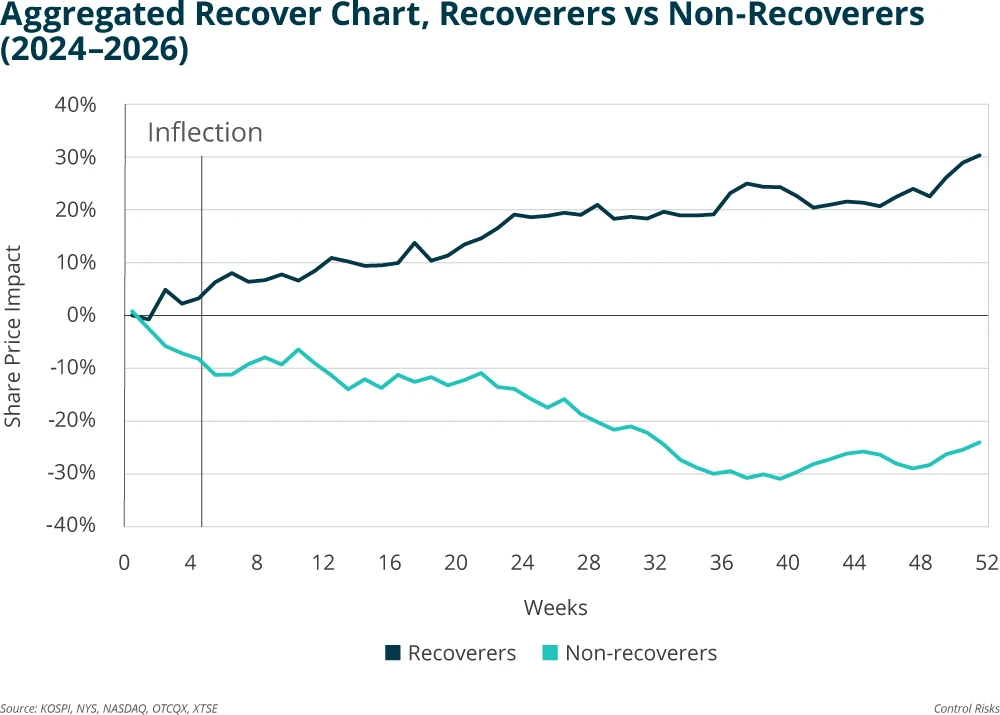
Organizations that emerged stronger had identified vulnerabilities before they became public, had crisis plans in place and acted decisively under scrutiny. Those that struggled entered the crisis with unresolved issues that the event exposed and amplified. While boards and executives cannot prevent every crisis, they can shape whether the market sees a temporary disruption or a deeper failure of leadership.
The crisis is rarely the beginning of the story
A crisis should be viewed as a critical inflection: the moment when existing vulnerabilities and lack of preparedness become visible to investors, stakeholders and the public.
Our research uncovered a recurring pattern. Reputational concerns, governance issues, stakeholder grievances and negative narratives often accumulate well before a high-stakes incident. When a crisis brings these unresolved risks into public view, impact suddenly becomes far greater than the event alone would suggest.
This is an important shift in how organizations should view crisis risk. While clients often ask which crisis could happen next, the more useful question is: what unresolved vulnerabilities would a crisis expose if it happened tomorrow? Organizations that focus only on responding to immediate incidents risk overlooking the conditions that make future crises more damaging.
Why today's operating environment raises the stakes
The operating environment has made those latent vulnerabilities more consequential.
Political polarization, social activism, reputational scrutiny and the heightened expectations of corporate behavior are creating new forms of exposure for organizations and their leaders. Companies are increasingly viewed as symbols of broader social, political and economic debates. As a result, issues that once remained confined to specific stakeholder groups can now spread rapidly across audiences, creating pressure from employees, customers, investors, regulators and activists simultaneously.
In this environment, a crisis can rapidly escalate beyond an operational or communications challenge. It can become a test of leadership credibility, governance effectiveness and organizational resilience. Investing in understanding vulnerabilities and monitoring emerging threats prepares leadership teams to act under pressure.
What separates recoverers from non-recoverers?
We identified three characteristics that consistently distinguish organizations that recover share value from those that experience prolonged decline: preparedness, leadership continuity and decisive crisis response.
Our analysis included wide-ranging cases like the Unilever dispute over political expression that led to the dismissal of subsidiary Ben and Jerry’s CEO and Target’s decision to roll back Diversity, Equity and Inclusion commitments, which triggered a sustained backlash.
Successful recoverers entered the crisis with fewer unresolved reputational and governance issues. Able to rely on greater preparedness, they demonstrated stronger leadership and an ability to make decisions quickly during periods of uncertainty. Most importantly, they established credible control of the situation before negative narratives could define the event for them.
For non-recoverers, the original event often became secondary to concerns about leadership and underlying organizational weaknesses or narratives. As investor confidence weakened, attention shifted to whether the organization had the governance and decision-making discipline to manage future risks.
This is where Control Risks’ Crisis Advisory work is most valuable. We help organizations look beyond the immediate incident to the vulnerabilities and decision points that shape recovery. By combining risk intelligence, governance insight, crisis management experience and practical preparedness exercises, we help boards and executive teams understand what must be in place to secure long-term value.
Leadership continuity is a value-protection issue
Our research points to a clear conclusion: leadership continuity is central to recovery.
Where senior leaders were suddenly unavailable, organizations with clear succession plans and rapid transition communications were better positioned to stabilize confidence and maintain momentum. Where leadership uncertainty persisted, we found it deepened existing concerns and slowed recovery.
For boards, the takeaway is broader than succession planning. Executive protection and leadership resilience should be treated as core value-protection measures. In a crisis, visible continuity signals control and steadies stakeholder confidence, giving the organization a stronger platform for recovery.
Recovery is built before the crisis
Organizations that emerged stronger after a crisis typically shared several practices:
- Continuous monitoring of emerging risks, stakeholder sentiment and evolving narratives.
- Clearly defined and regularly tested crisis management strategies.
- Leadership succession plans supported by realistic exercises and decision-making frameworks.
- A commitment to learning from incidents and strengthening resilience over time.
These practices shift the organization’s posture from incident handling to value recovery. Organizations that identify vulnerabilities earlier are able to make better decisions under pressure, and boards that have a clearer view of exposure can more effectively maintain stakeholder confidence throughout recovery. Together these are the factors that separate temporary disruption from long-term value destruction.
Contact Control Risks to find out more about the crisis recovery framework, case examples and findings from Control Risks' analysis of publicly listed companies.