
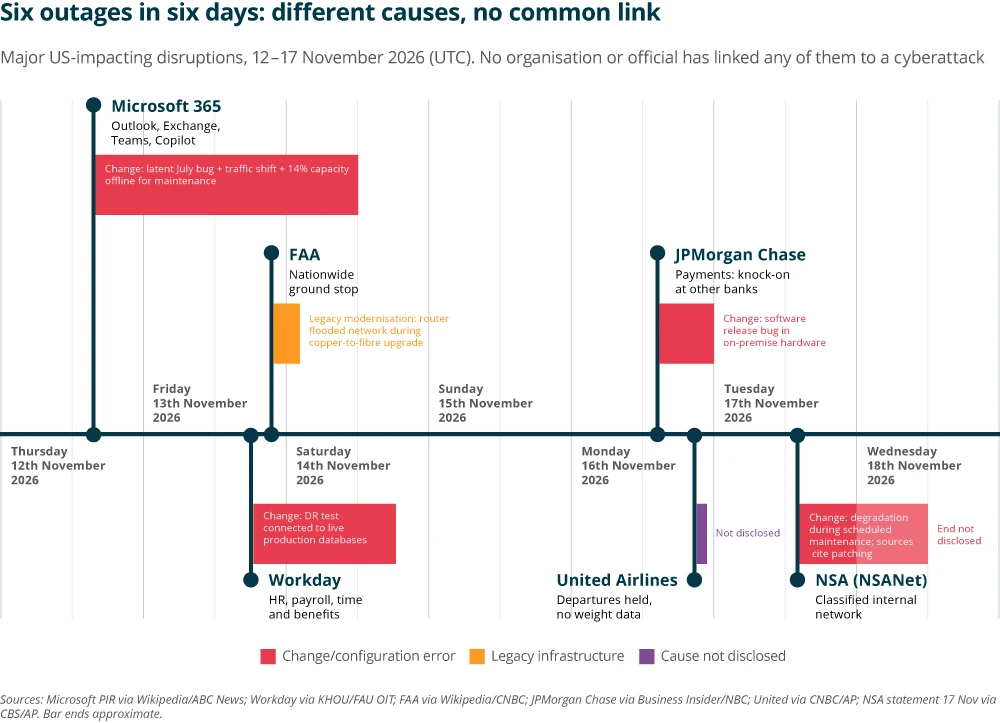
Over six days in November 2026, significant digital disruptions affected Microsoft 365, Workday, the US Federal Aviation Administration (FAA), JPMorgan Chase, United Airlines and the US National Security Agency (NSA). Email and business services were interrupted worldwide, employees lost access to payroll information, banking transactions were delayed and nearly 3,500 flights were held on the ground, while the NSA reported disruption to its classified internal network.
Although the timing and scale prompted widespread speculation that they might be connected as part of a coordinated attack, there is currently no evidence linking these incidents. The organisations that have commented publicly have either ruled out a cyber attack or identified a technical cause, and US officials have said there is no evidence of a cyber attack at the NSA. The causes identified so far are also unrelated.
However, taken together, these disruptive events highlight systemic fault lines in the global technology ecosystem. More importantly, they suggest that operating under degraded conditions is becoming a normal feature of business resilience rather than an exceptional event.
Why are large-scale digital disruptions becoming more common?
1. Change and configuration errors made under pressure
Four of the six November outages happened during or after a planned change. Microsoft traced its outage to a defect introduced in July, which was triggered by a traffic change while maintenance had taken 14% of gateway capacity offline. Workday’s disruption began when a disaster-recovery test connected to live production databases, whereas JPMorgan Chase identified a bug introduced by a software release. The NSA said its network was degraded during scheduled routine maintenance.
These failures are happening while technical teams are under heavy and growing pressure. AI is speeding up vulnerability discovery and exploitation, compressing the time available to assess and respond to emerging threats. In the latest quarter, 44,000 new CVE records were published, more than three times the 12,000 recorded in the same quarter a year earlier. Microsoft’s November monthly update alone fixed 1,094 vulnerabilities, two days before its outage began; there is no evidence the two are connected, but IT teams are managing a growing volume of vulnerabilities and increasing pressure to remediate them quickly. Every one of those fixes is a change to a live system, and each change carries some chance of breaking something. Faster and more frequent patching reduces exposure to attacks but can also increase operational risk.
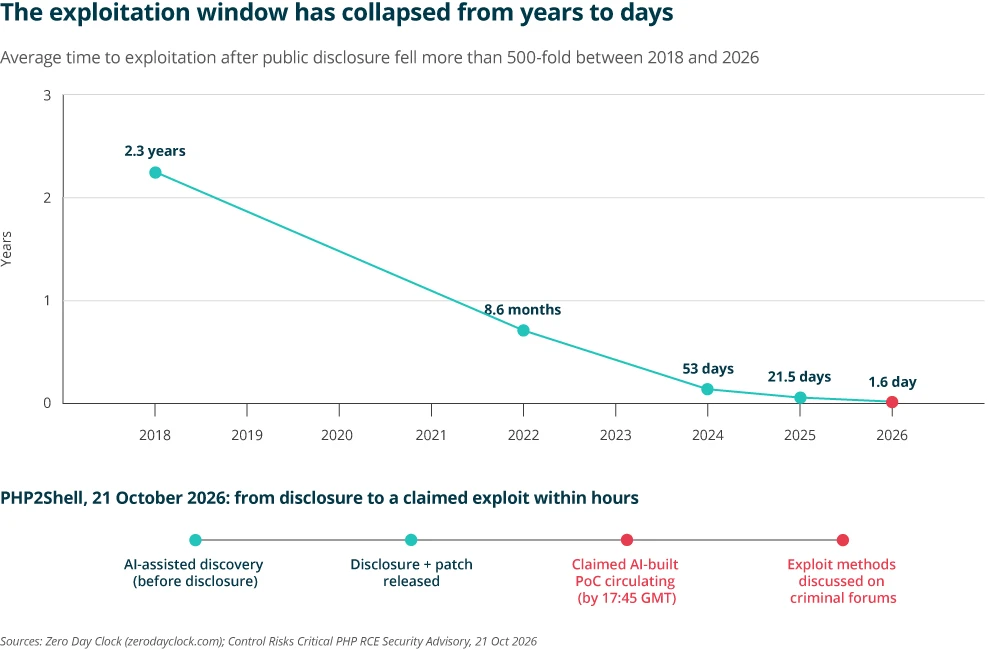
The October disclosure of two critical PHP vulnerabilities, reportedly found with AI assistance, illustrates this risk. A claimed AI-built proof-of-concept exploit was circulating within hours of disclosure. Mandiant estimates the average time between vulnerability disclosure and exploitation was negative seven days in 2025, meaning exploitation starts before a patch is available. Patching these PHP vulnerabilities has already been attributed to at least one outage: the US Director of National Intelligence attributed the NSA outage to PHP vulnerability patching, saying some systems did not come back online as expected.
2. Legacy infrastructure and modernisation debt
The FAA’s nationwide ground stop came from a newly installed router that flooded the network during a long-running copper-to-fibre upgrade. Modernising ageing but operationally critical infrastructure is slow and complex, and the transition from legacy to newer systems itself creates risk. For governments and private sector companies, managing this transition is as much a resilience challenge as a technology one.
3. Concentration risk amplifies disruption
Many organisations depend on the same small number of technology providers, meaning a failure affecting one provider can turn into a systemic event. The November disruptions demonstrated these knock-on effects: JPMorgan Chase’s software bug delayed payments at other banks and Microsoft’s outage disrupted a range of third-party services built on Microsoft 365. As with the CrowdStrike outage in 2024, how quickly the failure spread mattered more than its specific technical cause. Attackers could exploit the same dependencies, because disrupting a widely used provider can be cheap, deniable and have systemic effects.
Individually, each of these fault lines can be managed. The risk increases when they intersect. Rising change volumes, fragile legacy infrastructure and highly concentrated technology stacks combine to amplify the consequences. Concentration can also undermine recovery. An alternative environment or workaround provides little resilience if it depends on the same identity, data, communications or underlying infrastructure as the service that has failed.
Why degraded operations are becoming the new normal
Control Risks expects more of these failures. Vulnerability disclosure is accelerating, large-scale automated exploitation is following and technology stacks are becoming even more concentrated. The pressure on technical teams is therefore unlikely to ease, while the concentration of critical dependencies means individual failures will continue to have widespread consequences.
Organisations should plan accordingly, focusing not only on preventing failures but also limiting their consequences when they occur.
What should business leaders prioritise for 2027?
- Plan and exercise for degraded operations, not just recovery. Decide in advance which key business services must continue, at what minimum level and under whose authority.
- Contain consequences before they escalate. Design processes, communications and decision rights to stop a technical failure from becoming a customer, regulatory or reputational crisis.
- Map concentration across the supply chain. Identify the few platforms, cloud regions and software components that most critical processes depend on, including dependencies several layers down the supply chain. Ensure vendor management is integrated into core incident response and vulnerability remediation processes.
- Preserve portability and exit options. Identify the data, applications and digital assets essential to critical services and understand what would be required to recover or move them if a provider or region became unavailable. For critical dependencies, make sure the contractual rights, data portability and technical interoperability needed to move are established before a disruption occurs.
- Treat change management as a resilience control. As patching and reconfiguration speed up, invest in staged rollouts, testing, isolation of recovery environments and rollback. Measure how fast you can make changes safely, not just how fast you can patch. Determine in advance how urgent security changes will be assessed and deployed when the need to address threat exposure must be balanced against the risk of operational disruption.
- Use AI to reduce the workload on technical teams. Use it for triage and exposure analysis but verify its outputs against live environments before acting.
- Prepare leadership for attribution noise. Give boards a clear message during periods of disruption: the organisation does not need to know the cause of a failure before it can act to contain its impact.
Control Risks’ view
The disruptions of 2026 demonstrate how ordinary technical failures can have consequences far beyond the organisations in which they originate. The November outages saw firms largely choose patch immediacy at the cost of operational disruption. But it would be unwise to swing the extreme opposite way and choose unconditional resilience and patch perfection at the expense of threat exposure.
The organisations that cope best in 2027 will be those that refine the calculus in striking a balance, assume something critical will fail, understand what they depend on, know what their alternatives are, and have practised operating in a degraded state.
Control Risks helps organisations understand their exposure to digital disruption, identify the dependencies and vulnerabilities that matter most, and prioritise practical actions to strengthen resilience and maintain critical operations when disruption occurs. To learn more about how we can help, please visit Digital Risks.