
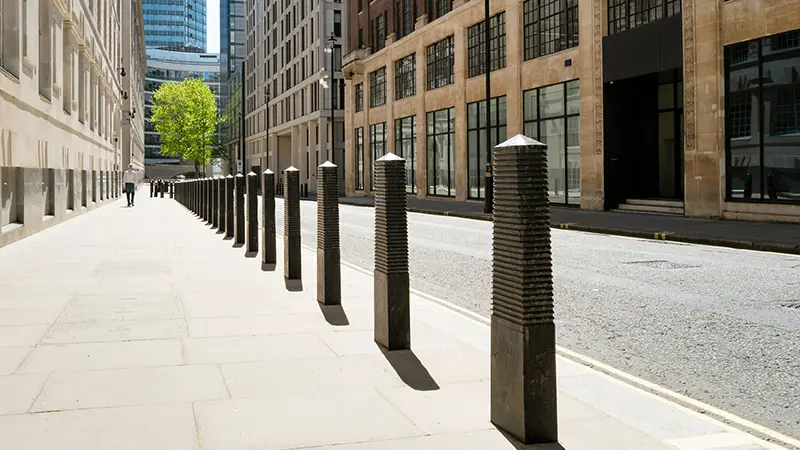
Urban security has evolved over the past two decades, where visibility is no longer a reliable measure of effectiveness. For many years, hostile vehicle mitigation has been associated with highly visible and standardised perimeter treatments, including continuous bollard runs, reinforced street furniture and rigid boundary lines. While these measures provide a baseline level of protection, they often do so in a way that is disconnected from how risk manifests within complex urban environments.
The transition from prescriptive hostile vehicle mitigation to evidence-based VDA reflects a broader evolution in urban security thinking. It represents a shift away from standardised protective solutions toward context driven, performance-based design.
As cities continue to prioritise openness, accessibility and high-quality placemaking, the tension between security and design intent is becoming more pronounced. Prescriptive solutions, when applied without detailed contextual understanding, can unintentionally compromise the usability and visual coherence of public space.
From prescriptive mitigation to evidence-based design
The emerging shift is toward performance-based security strategies informed by Vehicle Dynamics Assessment (VDA). Rather than relying on uniform assumptions about vehicle impact and standoff distances, a VDA examines how vehicles would realistically behave within a specific environment.
This includes analysis of approach geometry, acceleration potential, turning constraints and the influence of surrounding street networks. The key insight is that risk is not evenly distributed across a site. Certain areas may present no credible vehicle approach at all, while others contain limited but credible access pathways.
This reframes hostile vehicle mitigation from a perimeter-wide requirement into a targeted, evidence-led intervention strategy. Security becomes a function of spatial understanding rather than standardised physical repetition.
Refining risk and integrating security into design
Traditional HVM approaches often rely on conservative assumptions that lead to the blanket application of protective measures. While this ensures a baseline level of safety, it can also lead to over-design, where mitigation is applied more widely than necessary. This can result in a more visually cluttered and less welcoming public realm experience for users.
Evidence-based VDA challenges this by focusing on demonstrable risk pathways. By modelling realistic vehicle behaviour within the constraints of the urban environment, it becomes possible to identify where hostile access is feasible and where it is not. By understanding the achievable vehicle speeds, impact energy and impact locations, VDA provides a more practical and proportionate basis for defining security requirements than generic perimeter assumptions.
In many cases, this reveals that only specific points within a site require intervention, allowing the remainder of the environment to remain open and unobstructed. This creates a more proportionate balance between security and public realm quality.
One of the most significant advantages of this approach is its compatibility with architectural and landscape design intent. When security is informed by precise understanding of risk, it does not need to rely solely on overt or continuous barriers.
Conventional ApproachBlanket application of protective measures |
Risk-informed ApproachTargeted, proportionate and integrated design |
|

|
|
|
Instead, mitigation can be embedded within the spatial structure of the development. Vehicle movement can be naturally controlled through layout design, circulation patterns and subtle changes in level. Landscape elements such as seating, planters and street furniture can also contribute to passive mitigation when strategically designed and integrated within a VDA informed framework. This allows security to become part of the logic of the place, rather than a separate layer imposed onto it.
Mitigating over-design while improving proportionality
A common limitation of prescriptive HVM is the tendency toward over application of measures that are not always justified by site-specific risk. This can increase cost, reduce flexibility and negatively affect the quality of the public realm.
By contrast, VDA enables a more proportionate approach. Mitigation is directly linked to a defined understanding of threat scenarios and actual vehicle accessibility. This ensures that interventions are neither excessive nor insufficient but appropriately scaled to the environment in question.
In practical terms, this leads to more efficient use of space and resources, while maintaining a defensible security outcome.
The importance of early-stage integration
The effectiveness of VDA is highly dependent on when it is introduced into the design process. Once key decisions around layout, building placement and access strategy are fixed, opportunities for meaningful geometric mitigation become significantly limited.
When applied at the master planning stage, however, VDA can directly inform street hierarchy, vehicle circulation strategy, building orientation and the relationship between structures and the public realm. This early integration allows security to shape the design in a subtle and coherent way, rather than being retrofitted later through physical barriers.
Towards a more intelligent model of urban security
City planners, civil engineers and project owners should adopt a VDA-informed approach to urban planning, ensuring that developments remain open, functional and visually coherent while proportionately addressing credible vehicle threats. In doing so, they are responsible for delivering security strategies that are contextually informed, defensible and integrated into the wider design vision of the city. Ultimately, their objective is to prioritise solutions that are least visually intrusive, align with place-specific conditions and are seamlessly embedded into how urban environments are designed and operated.
Looking to integrate security into your designs without compromising usability or public space? Speak to our Built Environment and Infrastructure experts.
Article written by: Silvia Mehilli